Tradisang, cultura, cantiga, comeria, palabra

Bairro Portugues de Malacca
tradisang, cultura, cantiga, comeria, palabra...

local Portuguese cuisine.Kumiria di Portuges di Malaca.Cozinha de Portuges De Malaca.

Pineapple and prawns curry. Kari nanas kum kambrang. Ananas caril  com gamba.

Cucumber salad.Sambal pipinu kum deng raya. Pepino com peixe  seco salgado.

This dish is called 'Molio'. and its cooked with coconut milk,brinjal  with fish ball or fresh prawns. Molio. E 'Molio',cuzinha peixe,com leite de coco.

This a unique dish which is only cooked by the baba,nyonya and the Portuguese Of Malacca, it's famously known as Curry Keluak. Made of a special fruit found in Indonesia ,Sabah and Sarawak.Is usually cooked with pork,chicken or fish  'Kari Kluak', kuze kum porku,galinya,kum peisi malong,peisi sembilang. E caril 'keluak',cuzinha com carne de porco,carne de frango,piexe. Keluak,um fruto de Indonesia,Sabah com Sarawak...   

This is the seashell curry,cooked with semi riped papaya and coconut milk. Bredu Papaya kum siput cupak ku.  Papaya com um marisco,cuzinha com leite de coco. 

NATAL-CHRISTMAS

First,I would like to apologize for not adding new post into my blog for the past month. It's just that I've been busy with Christmas.

Christmas is known as 'Natal"among us in the Portuguese Settlement. It is celebrated on an elaborated scale with no efforts spared to make it a grand day. The hustle and bustle of the preparation usually commence one month before the Festival,the day after All Souls Day.Carols can be heard on the morning of November 3rd.Both parents and children actively engaged in cleaning and painting the house. Caroling and Nativity play practices will begin as well. Cakes and other delicacies are made.New attire,curtains and furnitures are bought or made. Mid December, Carolers will begin caroling from one resident to another,spreading the Christmas cheer.

By Christmas eve,all is set to welcome the birth of Baby Jesus. For that is the main reason we celebrate Christmas. Families welcome Christmas by participating the mid-night mass. After mass,it is tradition for the children to wish their parents'Bong Natal.' This is done by kissing the hands or chicks of the parents,always begining with the oldest. Then the family will sit down for Christmas supper. After supper, little children will open their presents.

On Christmas day, houses will be open for people to convey their greetings.Food and drinks are served. When children comes, it is a tradition to give some money as gifts to them.

In days gone by, a 'boboi' or swing wasswung from a big tree during the season of Advent. the old ladies of the community wake up early to each morning to sing the 'Nina boboi" and carols,as they swing along. This was their way of getting into the Christmas spirit. There is also another Portuguese song that is sung by old folks called the 'Pasturinho"(The Sheppard).The singing of these songs bring back memories of past Christmases. It was the belief of the old that Christmas is incomplete if the'Nina Boboi" is not heard.

Maszianti,yeo kere pidi pedromi,kauzu ja ungwa mis yeo nungka skribe na blog. Muito tantu sibrisu antu de Natal.


Nos na Malaca fala Natal.Kiora ja kaba benze koba,tres de Novembro,nos podi ubi kantiga de Natal. Mai pai kum keriansa logo pinta casa kum faze limpu casa. Keriasa logo bai prende kanta kantiga de Natal. Mai logo fase bolo koku,tar,sesagung acar chili mas tantu kumiria...


Na pamiang di anoiti di Natal, nos logo bai ola koba di nos sa jirisang keng ja bai di nos sa mundu.
Anoiti di Natal nos tudu logo bai misa di gresa st.Peter. kaba misa, nos na casa, logo da mang maszianti kum jenti idadi. kaba da mang, nos logo santa kumi kumiria para Natal.Pai,galinya asadu,kari debal,acar chili kum agar-agar. kaba kumi, keriansa logo abri sa ardansa ki eliotu komfia Santa Clause ja da. 


Pamiang di Natal,mai logo igri sedu kuze mas kzri debal,kari seku, sebak, chap chai,stew para da jenti kumi. Nos logo abri porta 10 oras pamiang para jenti beng abiza kum nos. 


Gostaria de pedir desculpas por não ter adicionado novos post's no blog o mês passado mas estive muito atarefada a preparar o Natal.


O Natal é conhecido como "Natal", entre nós, no Bairro Português sendo comemorado como um  grande dia. A azáfama da preparação geralmente começa um mês antes, no dia seguinte ao dia de Todas as Almas.
As cantigas de Natal podem ser ouvidas na manhã do dia 3 de Novembro. Tanto pais como filhos participam activamente na limpeza das suas casas. Tanto os ensaios das peças de teatro de Natal, como das cantigas começam também nessa altura Bolos e outras iguarias são feitos. Novo vestuário, cortinas e móveis são comprados ou feitos. 
A meio de Dezembro, as crianças começam a cantar de casa em casa, espalhando a alegria do Natal. 


Na véspera de Natal, tudo está pronto para receber o nascimento do Menino Jesus. Essa é a principal razão para celebrar o Natal. As Famílias dão as boas-vindas ao Natal indo à missa da meia-noite. Após a missa, é tradição que as crianças desejem aos seus pais "Bong Natal", acompanhado com um beijo nas mãos ou na cara dos pais, começamdo sempre pelo mais velho. Depois a família prepara-se para o jantar de Natal. Depois do jantar, as crianças vão abrir os seus presentes. 


No dia de Natal, os residentes do Bairro Português abrem as portas das suas casa para que as pessoas as possam felicitar e desejar um "Bong Natal" . Comida e bebidas são servidas. Quando as crianças chegam, é tradição dar algum dinheiro como presente.


Em tempos idos, um 'boboi' ou swing oscilou de uma grande árvore durante o tempo do Advento. As velhas senhoras da comunidade acordavam cedo todas as manhãs para cantar a 'Nina Boboi" e canções de natal, como swing longo. 


Esta era uma forma de entrar no espírito natalicio. Há também outra canção Portuguesa que é cantada pelos mais velhos chamada "Pasturinho" (O Sheppard).
O canto dessas canções trazem de volta memórias de Natais passados. É na crença dos antigos que o Natal é incompleto se "Nina Boboi" não é ouvida.


Just to show this picture.

This picture shows,Mr.Noel Felix and Aunty Rozil doing the 'mata kantiga'.
Na isti pintura Senor Noel Felix kum Senora Rozil,ta kanta 'Mata kantiga'.

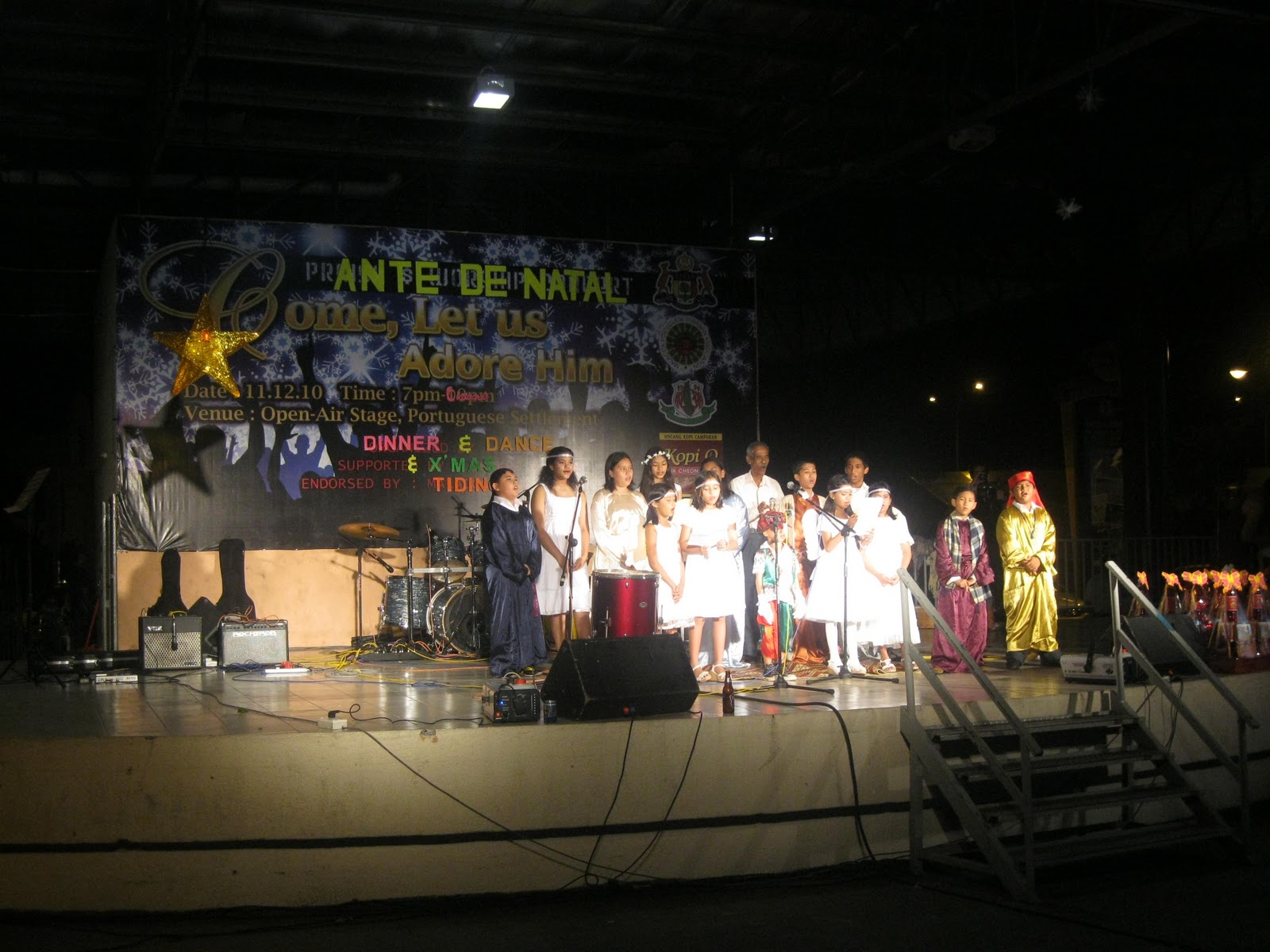
Part 2 of the Nativity play.

My youngest son,Sheldon,5, as the little drummer boy.Mia mininu ,Sheldon,5,fika fila kum tambor.


Presenting the 3 wisemen,Isiah,Mark and Seth. 3 sabio omi,Isiah,Mark kum Seth.


Children to the tune Joy to the world. Keriasa bala JOY TO THE WORLD.


Christmas Pageant in Malacca Portuguese.Noiti di Natal na linguada Portuges de Malaca.

Katrina Zuzatee as the mother Mary..,Katrina Zuzatee fika Maria

Amerlyn as the angel Gabriel. Amerlyn fika,anju Gabriella."nang midu,yoe beng kum nobos bong."

Jessica Van Huisen as Elesaberth.Jessica Van Huisen ,fika Elizabet,"ditudu jenti bos kum bos mininu,muitu bensuadu"

Angle said to Joseph,Do not be afraid to take Mary as your wife.Anju fala,nang midu panya Maria fika bos sa mulier.

3 wise men came. 3 sabio omi beng encontra kum mininu de Deus.

Angels with the sheppards.Anju kum pastorinhos


Children singing carols in Portuguese,O holly night,Silent night, angels we have heard on high.Keriansa kanta na Portuges de Malaca,Tresti di anoiti,Bensua di Anoiti kum anju nos ta kanta.

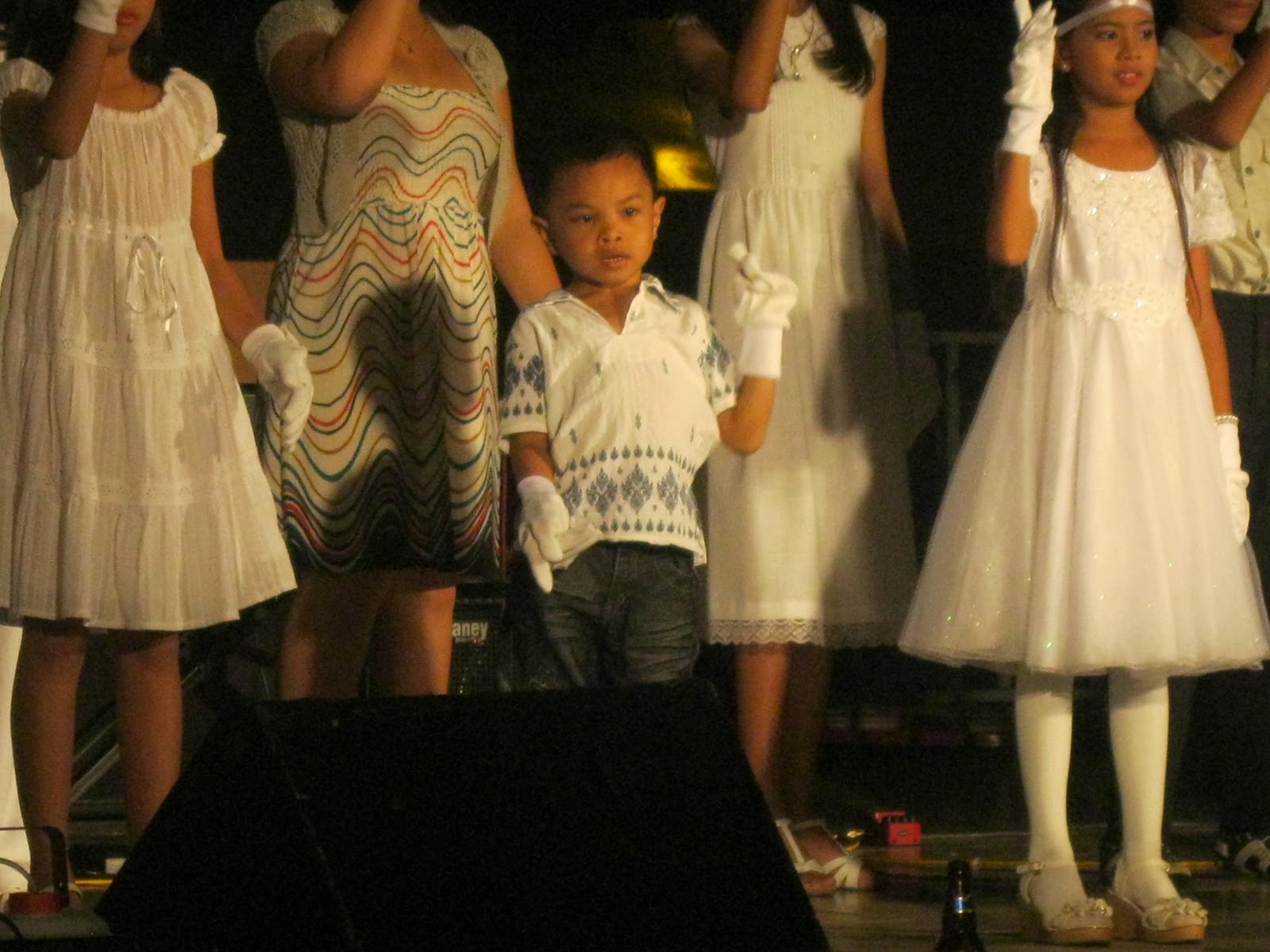
children dancing to the song,GOD IS GOOD.Keriansa bala kantiga "GOD IS GOOD".


Our Dances./ Nos sa Balu/As nossas dancas..

The "Branyo" is in fact the only dance that has survived throughout all these years of change.This might be because of its sheer simplicity. It is very easily learnt and it can be performed to either a local Portuguese melody or any Malay ronggeng tune for that matter. Although the "branyo" has survived,there are versions of it that have gone out of practice.

Among these are the 'branyo sinta' and the 'branyo rudia'. The branyo sinta is three days of wining and dancing in the fancy dress,beginning on the last Sunday(Intrudu)( also known as water festival) before Lent to the Tuesday(shrove Tuesday) before Ash Wednesday. This went out of existence more than 20 years ago.But it has sinced been revived.

The 'branyo rudia' or travelling dance formed the highlight of the Fiesta San Juan and San Pedro.Feast of Sts John,and Peter.(beginning 23rd June to 29th June). The dance would start off with a small group in the early evening after the Thanksgiving Mass. It snowballs from house to house,climaxing at the open air stage area of the Portuguese Settlement.This would go on till the wee hours of the morning.

As mention above, the branyo is usually accompanied by the "mata Kantiga.". Mata kantiga is similar to the Malay version,dondang sayang. The only different is,it is an  impromptu composition of verses is an art in itself.  There seems to be very few among the older people today who can handle this art. Efforts are being made by members of the MPEA(Melaka Portuguese Eurasian Assosiation)to revive this by forming an Academy of fine Arts for the young ones to come and learn the language as well as the traditions and culture. Let not this tradition and heritage be lost.

Teng ungwa balu,nos ja gadra asoti tempu, branyo.Nos sa abo disabo ja trize na Malaca. Kauzu isti balu tudu jenti podi bala. Nos podi bala kum kantiga de Portugues. Isti balu muito popular na isti terra,Malayu coma joget..Nos ja gadra branyo,mas teng mas branyo ki nos nungka muito bala mas. Branyo sinta kum branyo rudia.


Branyo sinta,nos logo bebe kum bala para tres dia.Nos logo bisti nasang-nasang sa bistidu. Omi logo bisti  bistidu de femi,justu cuma festival na Portugal.Branyo sinta,komesa,Domingu anti Kuarta Fera di Sinza. binti anu nos nungka bala balu sinta,mas agora,balu sinta ja teng di tona.


Beng Feasta San Juan kum San Pedro, nos logo komesa kum misa. Kaba misa, branyo rudia logo komesa. Nos logo bala casa de casa,ati nos chega na stradu kampu,na bairo de Portugues. Nos logo alegria ati oras ungwa pamiang.


 Ki nos sabe,branyo,sempre acompinyadu kum mata kantiga.Mata kantiga igual kum dondang sayang mas umpoku defrenti,mata kantiga nos kanta impromtu,seng di scribe ki nos kere fala. Isti faze mata kantiga unique.Nungka tantu jenti idadi sabe kanta mata kantiga. Teng ungwa associacao,Associacao De Portugues de Malaca, ta prende keriansa linguaze,tradisang,cultural,kantiga kum balu. Beng nos juntadu nang da nos sa tradisang kum heranca pedre di mundu.


O "Branyo" é na verdade a única dança que tem sobrevivido durante todos esses anos de alteracao.Esta pode ser por causa de sua absoluta simplicidade. É muito fácil de aprender e pode serrealizada a qualquer uma melodia locais Português ou qualquer melodia Malaio ronggeng para essa matéria


.Embora o "branyo" tem sobrevivido, há versões de que ele tenha saído da prática.Entre estes estão a "Sinta branyo 'eo' rudia branyo. A Sinta branyo é de três dias debeber e dançar, a fantasia, começando no último domingo (Intrudu) (também conhecido comoFestival da água) antes da Quaresma para a terça-feira (Terça-feira Gorda), antes das Cinzas. Esta foide existência de mais de 20 anos .
Mas tem foi revivido.


O 'rudia branyo' ou dançar viajar formado o destaque do Fiesta de San Juan e San Pedro. (Início  23-29 de Junho). O baile iria começarfora com um pequeno grupo no início da noite após a missa de Ação de Graças É bolas de neve a partir decasa em casa, culminando na área ao ar livre fase na bairo de Portugues.
Esta Português alegrias até as primeiras horas da manhã.


Como mencionado acima, o branyo é geralmente acompanhada pela "mata Kantiga.".kantiga Mata ésemelhante à versão malaio, dondang sayang. O diferente é só, é um improvisocomposição dos versos é uma arte em si.


 Parece haver muito poucos entre os mais velhoshoje as pessoas que podem lidar com esta arte. Esforços estão sendo feitos por membros do MPEA (MelakaPortuguês Eurásia Assosiation) para reviver esta formando uma Academia de Belas Artes para oos jovens a vir e aprender a língua, bem como as tradições e cultura. Que nãoessa tradição e do património ser perdida.


Yo ta impe na mui di rua.-I am standing in the middle of the road. Estou em pé no meio da rua.


Yo ta bebe agu friu.-I am drinking cold water.-Eu estou a beber água fria.


Yo ta kumi aros.- I am eating rice..- Eu estou comendo arroz..


Yo ta kumi bagar.- I am eating slowly. Eu estou comendo devagar


Yo ta anda prestadu.-I am walking fast.-Eu estou andando rápido.

On Board the SAGRES. Na riba di barku SAGRES.A bordo no navio SAGRES.

On 24th October,2010, the long awaited SAGRES ship from Portugal ,arrived at the Straits of Malacca. I was given the opportunity to go on board. We took a 15 minutes boat ride from the Parameswara Jetty to the ship.  We managed to purchase some beers from the ship and were also given some complementary beers. Some of the sailors were friendly but there were some who shy away from us. Probably they were afraid that we were not able to communicate. Anyway, there were cultural performances by our local dance troupe. Overall, I had a great time.

  24 Outubro,2010, barku di SAGRES ja cega na nos sa praya na Malaca.Nos tudu ja bai kum ungwa perau. Nos toma,15 minutu nubu nos chega na barku.Na barku nos ja bai rudia,teng balu,di nos sa troupa Nos ja compra beberaza kum nos juntadu ja aca beberaza na riba di barku.Nos tudu muito alegria na barku.

No dia 24 Outubro,2010,N.R.P. SAGRES chegou a Malaca.
Ja estavamos a espera ha muito tempo para o visitar.
Fomos ate ao Navio num pequeno ferry que demorou 15 minutos a la chegar.

Compramos uma grade de cerveja para beber no Navio.Diverti-me muito. Adeus.
Ate sempre.